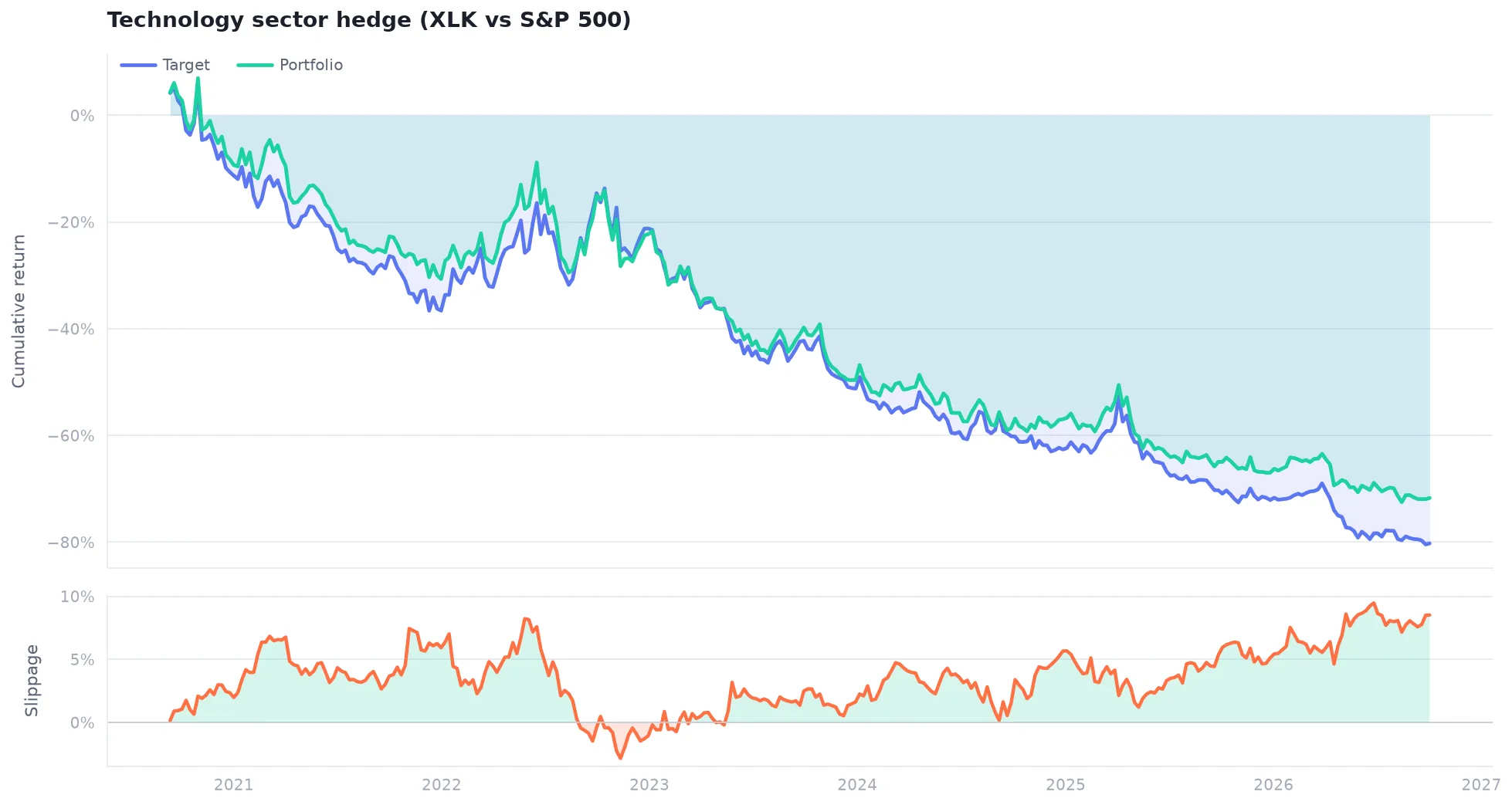
Hedge sectors and factors by name
When the exposure to offset is a well-known sector or style factor, send a canonical name instead of loading return series yourself. The server resolves the name to a US-listed ETF proxy, fetches aligned daily returns, and runs offset mode against a fixed S&P 500 basket.
Same ReplicationResponse as
/v1/offset — weights, portfolio vs. target
series, and tracking metrics. Invalid names return
422. See the
hedge request reference
for the full allowlist.
POST /v1/hedge-sector
Eleven GICS sector names map to SPDR sector ETFs. The
basket is always S&P 500; optional
exclude_tickers removes names from the
basket.
{
  "sector": "technology",
  "config": {
    "rebalance_freq": "weekly",
    "max_allocation": 10
  }
}
Illustration: offset XLK co-movement with an S&P 500 basket — no target or basket payload required.
technology · financials ·
energy · healthcare ·
consumer_discretionary · …
POST /v1/hedge-factor
Five style factor names map to US-listed factor ETFs. Same server-side data loading and offset logic as hedge-sector.
{
  "factor": "momentum",
  "config": {
    "rebalance_freq": "weekly",
    "max_allocation": 10
  }
}
Illustration: offset MTUM co-movement with an S&P 500 basket — illustration only.
momentum · quality ·
value · low_volatility ·
size
When to use hedge shortcuts
Use hedge-sector / hedge-factor
- Exposure matches a preset GICS sector or style factor
- You want the server to load ETF and S&P 500 data
- A single name in the JSON body is enough
Use /v1/offset instead
- Custom target return series (stock, fund, synthetic)
- Non–S&P 500 basket (Nasdaq-100, UCITS, etc.)
- You already have aligned returns in your pipeline
Where research teams apply it
Portfolio construction, risk analysis, and execution research — anywhere a liquid proxy or hedge for a return series is needed.
US ETF returns via UCITS instruments
Target a US-domiciled ETF return series and replicate it from a curated UCITS basket — matching the return profile with instruments that may carry different withholding treatment.
Illustration: SPY or a US sector ETF as
target, basket from the ucits_etfs universe.
High-fee fund proxies
Approximate an expensive or gated fund's return profile with liquid stocks and ETFs. Every run includes correlation and tracking-error metrics.
Illustration: emerging-markets ETF target with an S&P 500 subset basket, or a macro ETF basket against a multi-asset fund series.
Restricted holdings
When a concentrated position cannot be sold — employer stock, a lock-up, or a restricted lot — offset mode builds a long/short basket designed to neutralize that exposure.
Illustration: single-name or sector ETF exposure held without a sale.
Thin or illiquid markets
Funds with wide spreads, lagged NAV, or low volume can be approximated with liquid instruments from your candidate basket.
Illustration: niche factor ETF or alternative strategy series with a broad equity or US-listed-ETF universe.
Multi-asset and macro funds
Replicate managed-futures, risk-parity, or other multi-asset return series with a basket of US-listed ETFs across equities, bonds, commodities, and currencies.
Illustration: trend-following fund series
with SPY, TLT, GLD, and FX ETFs from the
us_listed_etfs universe.
What the API returns
Server-side optimization from aligned return inputs. You source the data; the API runs the loop and ships structured outputs.
Replication mode
Weights designed to track a target ETF, fund, or synthetic return series — with portfolio vs. target metrics on every run.
Offset mode
Weights designed to neutralize target exposure — concentrated stock, restricted holdings, and sector overlays.
Hedge shortcuts
/v1/hedge-sector and
/v1/hedge-factor — pass a sector or factor
name; the server resolves to an ETF, loads
S&P 500 returns, and runs offset. Same response
shape as replication and offset. Details in the
hedge request reference.
Input validation
/v1/validate checks calendars and window
sizes before a full run — free and unlimited on all
plans.
Preset universes
S&P 500, Nasdaq 100, FTSE 100, US-listed ETFs, or UCITS ETFs — pass a name instead of return series on Starter plans.
Flexible rebalancing
Daily or weekly rebalance schedules, position limits
via max_allocation, and long/short
constraints.
Four steps to your first response
From API key to weights in a single POST.
Request a key
Email us with your integration plan. Testing credits are free — no credit card required.
Validate inputs
Call /v1/validate to confirm calendars and
window sizes before spending a replication call.
POST your request
Send aligned returns to /v1/replication or
/v1/offset, or pass a sector or factor name to
/v1/hedge-sector or /v1/hedge-factor.
Use the outputs
Rebalance weights, tracking metrics, and portfolio vs. target return series — ready for your pipeline.
Proof on real data
Sector and factor hedges, single-name offsets, and ETF replication on live market data — each chart compares cumulative target vs. portfolio returns with tracking slippage.
Example charts are generated at deploy time.
Replication, offset & hedge methodology
How weights are estimated, with tracking statistics and charts from all site examples — including sector and factor hedges.
Ready to integrate?
Explore live charts first, then request free testing credits. Typical API key response within one business day.